
Retracting idler
Follow wrap, clearance, idler speed and span tension as a roller leaves a moving web and returns to it.
What happens when a roller leaves the moving web?
The retracting roller and its web
A prismatic slide lowers the apex roll of a taut three-roll line, with a driven roll upstream and an idling roll downstream. Boundary forces hold the web at its nominal tension. The assembly diagram identifies the roller arrangement, while the animation shows the idler lowering and rising. The slide retracts from 5 to 10 s, holds the idler out until 15 s and returns it by 20 s. The idler releases when it clears the common tangent of the neighbouring spans.
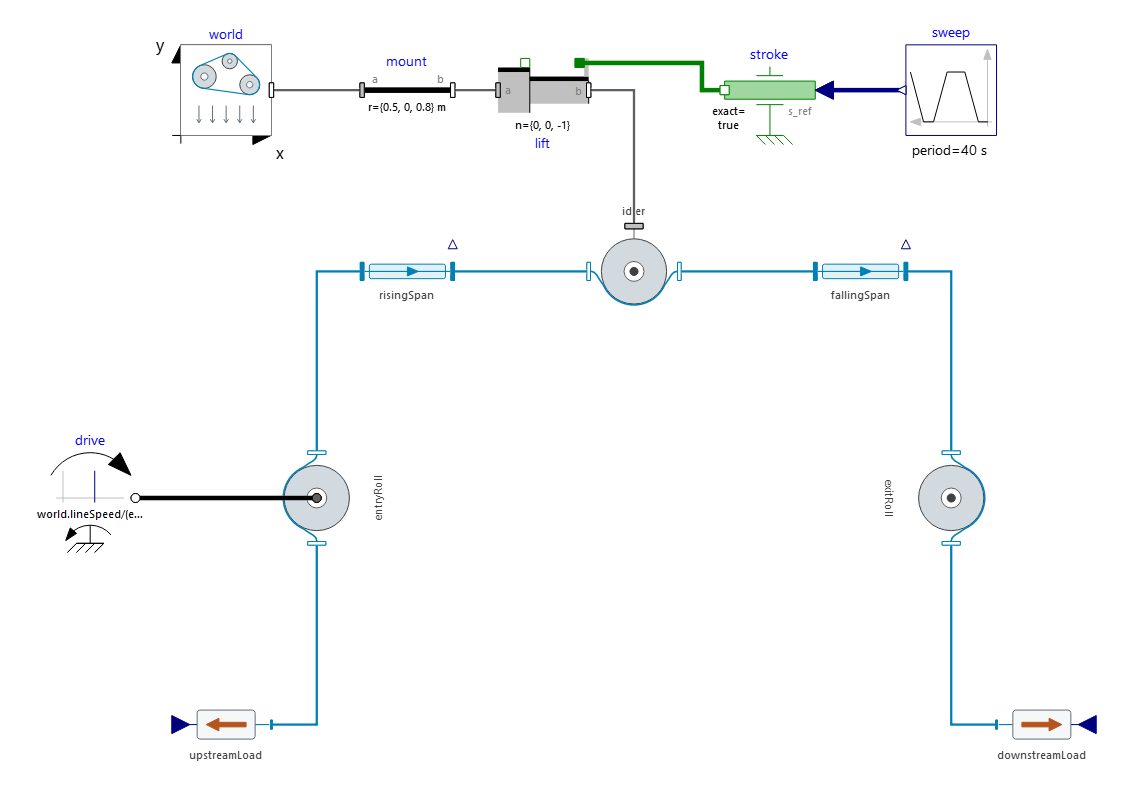
Model: Roll2RollDynamics.Examples.RetractingIdler · open source on GitHub
Wrap, clearance and release
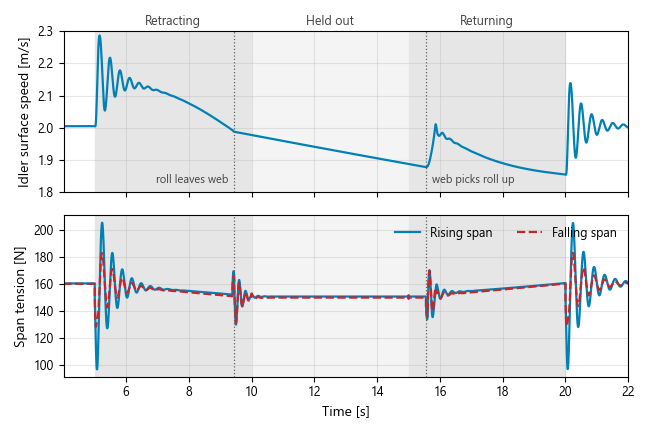
Read the wrap and clearance plot first: wrap falls to zero before clearance increases, and reversing the slide restores contact. The speed and tension plot shades the three phases. The web leaves the roll at about 9.4 s and picks it up again at about 15.6 s. While clear, the idler coasts down from about 1.98 to 1.89 m/s.
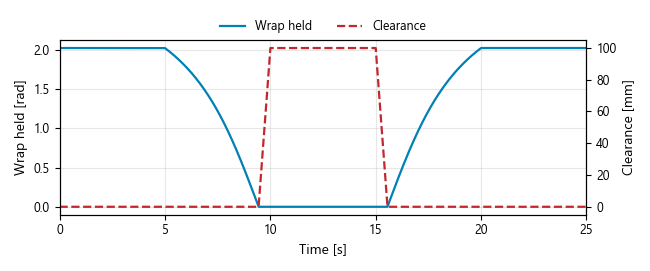
Span tension holds near 150 N, with ±17 N disturbances at release and pick-up. The larger swings where the slide starts and stops come from its prescribed acceleration. Reducing the stroke amplitude below 0.8 m retains contact; full retraction at 0.9 m gives about 0.0998 m of clearance.
More from Roll2RollDynamics
Misaligned idler
Explore how a small roller misalignment changes web tracking while span tension remains nearly unchanged.
Explore example →Nip loading
Follow nip engagement and release to connect contact load with traction and roller spin-up.
Explore example →